
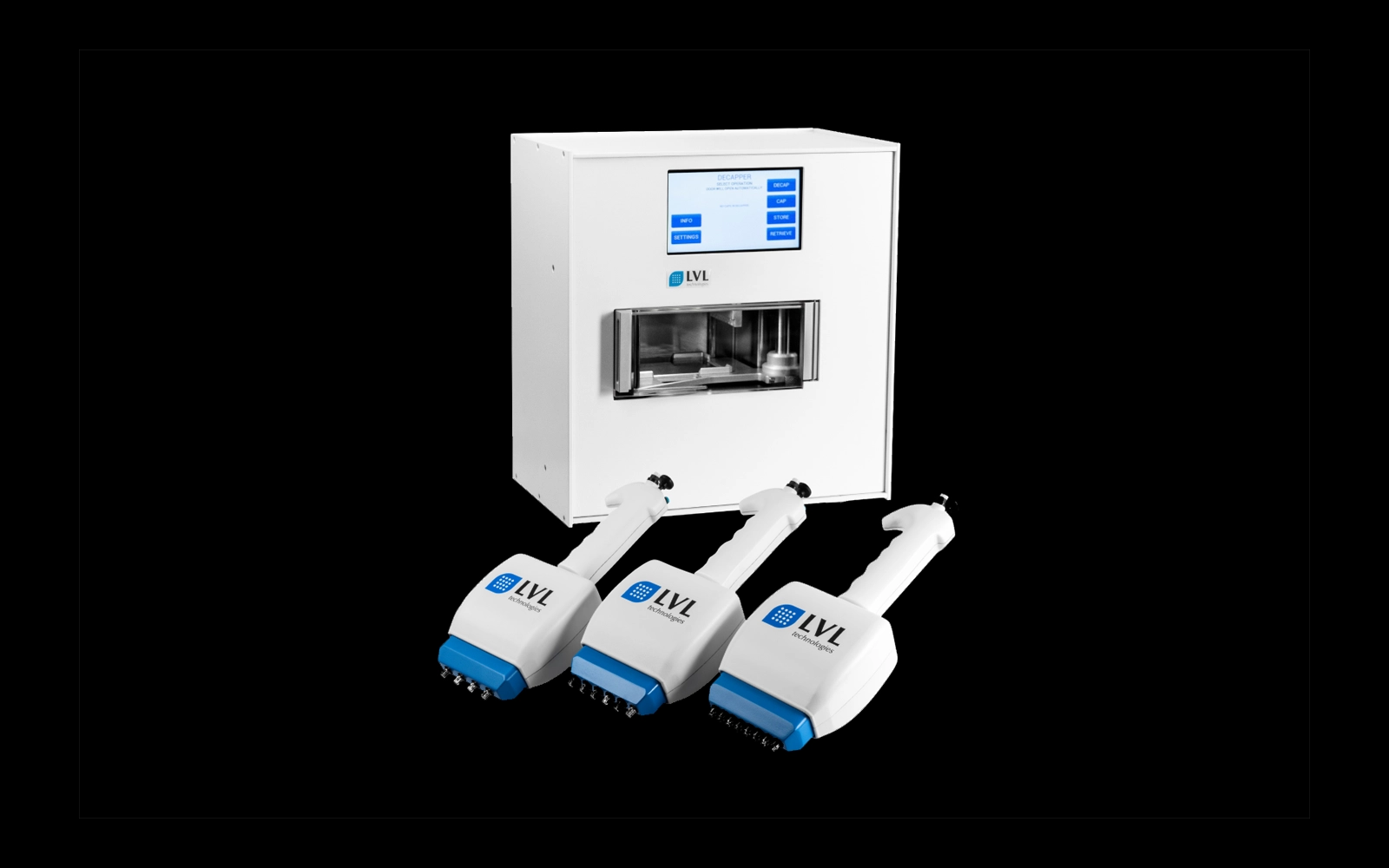
Unlocking Laboratory Efficiency with LVL Technologies Automated Decappers
May 19, 2026
How automated decapping technology is reshaping sample preparation, protecting lab personnel, and driving reproducibility at scale.
In a high-throughput laboratory, the seemingly small act of removing a sample tube cap can quietly become one of the most time-consuming, injury-prone, and error-generating steps in the entire workflow. Multiply that across hundreds or thousands of tubes per day, and the cumulative impact on personnel health, throughput, and data integrity is impossible to ignore.
2D Tubes by AutoGen has built a compelling answer to this challenge. Their automated decapping systems from LVL Technologies are purpose-designed for the realities of modern labs — from clinical diagnostics and biobanking to pharmaceutical research and forensic sciences. This post examines why an increasing number of laboratory managers are making automated decapping a cornerstone of their automation strategy.
The Hidden Costs of Manual Decapping
Before exploring the benefits of automation, it is worth understanding what manual decapping actually costs a laboratory. The burdens are not always visible on a spreadsheet, but they add up in ways that affect every level of operation.
Repetitive manual decapping is a well-documented contributor to musculoskeletal disorders in laboratory personnel, particularly affecting the wrists, hands, and forearms.There is also the throughput ceiling. A skilled technician can decap a finite number of tubes per hour before fatigue, distraction, or simple physical limits set in. As sample volumes scale upward, manual processes simply do not scale with them — and the bottleneck becomes compressive.
“Automation does not replace the scientist — it liberates them from the repetitive so they can focus on the irreplaceable.”
Key Lab Benefits of LVL Technologies Automated Decappers
LVL Technologies designs their decapping systems around the practical needs of working labs. The advantages span personnel welfare, operational efficiency, data quality, and integration flexibility.
▶ Improved Operator Safety and Ergonomics
LVL’s automated decappers eliminate the physical strain of repetitive twisting and pulling motions. By mechanizing this task entirely, labs dramatically reduce cumulative trauma injury risk for technicians. The system also provides a contained decapping environment, significantly limiting aerosol generation and splash exposure — a critical advantage when working with biohazardous, infectious, or chemically volatile samples.
▶ Dramatically Increased Throughput
LVL’s systems are capable of processing high volumes of tubes continuously without the fatigue, break time, or speed variation that characterize manual workflows. For labs running large batches — clinical labs receiving morning specimen rushes, biobanks processing cohort samples, or research facilities running multi-plate experiments — automated decapping removes a throughput bottleneck that can hold back downstream instrumentation and analytical capacity.
▶ Consistent, Reproducible Processing
Human variability is an underappreciated source of pre-analytical error. The torque applied during manual decapping, the speed of cap removal, and the handling angle all differ between operators and across shifts. LVL’s automated systems apply consistent, precisely controlled decapping parameters to every tube, every time — reducing variability at the sample preparation stage and supporting the reproducibility demands of regulated environments such as CAP-accredited clinical labs, ISO-certified research facilities, and GMP pharmaceutical workflows.
▶ Seamless Integration with Laboratory Automation Systems
LVL’s decappers are engineered for integration within broader automated workflows. They are designed to work alongside liquid handlers, centrifuges, analyzers, and laboratory information management systems (LIMS). This compatibility is essential for labs building end-to-end automation pipelines. Rather than being an isolated island of automation, an LVL decapper becomes a productive node in a connected, streamlined laboratory infrastructure.
▶ Reduced Sample Contamination Risk
Manual handling increases the opportunity for cross-contamination between samples through incidental contact, drips, and aerosol carry-over. Automated decapping confines the removal process and minimizes the number of physical touchpoints between personnel and open sample containers. For labs where sample integrity is paramount — genomics, proteomics, toxicology, transplant diagnostics — this reduction in contamination risk has a direct impact on result validity and patient safety.
▶ Staff Reallocation to Higher-Value Activities
When automated systems absorb repetitive, low-complexity tasks like decapping, skilled laboratory personnel are freed to contribute to activities that genuinely require human expertise — instrument troubleshooting, result interpretation, quality assurance, and patient-facing responsibilities. This reallocation is not just an efficiency gain; it is a quality-of-work improvement that contributes to staff retention and morale in a sector where talent is competitive.
▶ Audit Trail and Traceability
In regulated laboratory environments, documentation is not optional — it is a compliance requirement. these automated systems support the capture of processing data, including timestamps, batch identifiers, and error flags. This operational traceability supports audit readiness and strengthens chain-of-custody documentation, which is particularly valuable in forensic, clinical, and pharmaceutical laboratory settings where process integrity must be demonstrable.
▶ Wide Tube and Cap Format Compatibility
Real laboratory environments are messy in terms of tube formats — different manufacturers, cap types, tube sizes, and closure mechanisms are common across a single lab’s workflow. LVL Technologies designs their decapping systems to accommodate a wide range of tube formats and cap styles without requiring manual changeovers for each different type. This format flexibility makes the system practical across diverse departments and workflow types without necessitating tube standardization as a prerequisite for adoption.
In Numbers: The Impact of Decapping Automation
| 90% Reduction in RSI risk from manual decapping | 3–5× Throughput improvement over manual workflows | <1% Cap removal error rate in automated systems | 100% Elimination of aerosol exposure during decapping |
Statistics reflect general performance benchmarks.
Who Benefits Most?
While virtually any lab processing significant tube volumes will find value in automated decapping, certain environments see the most compelling return on investment:
Clinical and Diagnostic Laboratories
High-volume clinical labs — hospital core labs, reference laboratories, blood banks — process thousands of patient specimens daily, often under strict turnaround time requirements. Automated decapping directly addresses throughput constraints and supports biosafety compliance for infectious disease testing, hematology, and chemistry panels.
Biobanking and Biorepositories
Biobanks working with large cohort collections require consistent sample handling to preserve specimen integrity over time. Automated decapping reduces handling-related pre-analytical variability, protecting the value of irreplaceable long-term collections.
Pharmaceutical and Contract Research Organizations
CROs and pharmaceutical labs operating under GMP or GLP frameworks require documented, reproducible processes. Automated decapping supports compliance by removing operator-dependent variability and generating the audit-ready data trails these regulated environments demand.
Forensic Science Laboratories
Chain of custody and contamination prevention are existential requirements in forensic contexts. Automated, traceable decapping strengthens the integrity of forensic evidence handling from the moment of sample entry into the analytical workflow.
Practical Considerations for Implementation
Adopting an automated decapper is a meaningful workflow change, not just a capital equipment purchase. Labs should evaluate several practical dimensions:
Tube and cap inventory compatibility. Before implementation, map the full range of tube formats currently in use across your lab. LVL’s compatibility range is broad, but confirming coverage for your specific consumables avoids post-purchase surprises.
Integration architecture. Consider how the decapper will interface with upstream sample routing and downstream analytical instruments. Labs with existing automation middleware or LIMS infrastructure should engage 2D Tubes by AutoGen integration support team early in the planning process.
Validation requirements. For regulated labs, automated systems require method validation before they can be formally adopted into routine workflows. Plan for this validation period when building your implementation timeline.
Throughput modeling. Match the system capacity to your actual peak throughput demands. Under-specifying leads to residual bottlenecks; over-specifying leads to underutilized capital investment. LVL’s team can assist with capacity modeling based on your sample volume profiles.
The Case for Automated Decapping is Clear
2D Tubes by AutoGen automated decappers from LVL Technologies represent more than a convenience — they are a strategic investment in laboratory safety, reproducibility, throughput, and staff welfare. As sample volumes grow and regulatory expectations intensify, automated decapping is becoming a foundational component of the modern, well-designed laboratory.
For labs still relying on manual decapping, the question is less whether to automate and more when. The efficiency gains, safety improvements, and quality assurance benefits compound over time, making earlier adoption consistently more advantageous.
To learn more about our full range of automated decapping solutions, visit www.2D-Tubes.com or call 774.233.3000 to speak with a laboratory automation specialist about how our systems can be configured for your specific workflow requirements.