
What Makes a Great 2D-Coded Tube?
In the world of biobanking, diagnostics, and laboratory automation, not all sample storage tubes are created equal. A great 2D-coded tube is the unsung hero of sample traceability — quietly ensuring that every specimen, from blood draw to freezer to analysis, is tracked with precision and reliability.
What Is a 2D-Coded Tube?
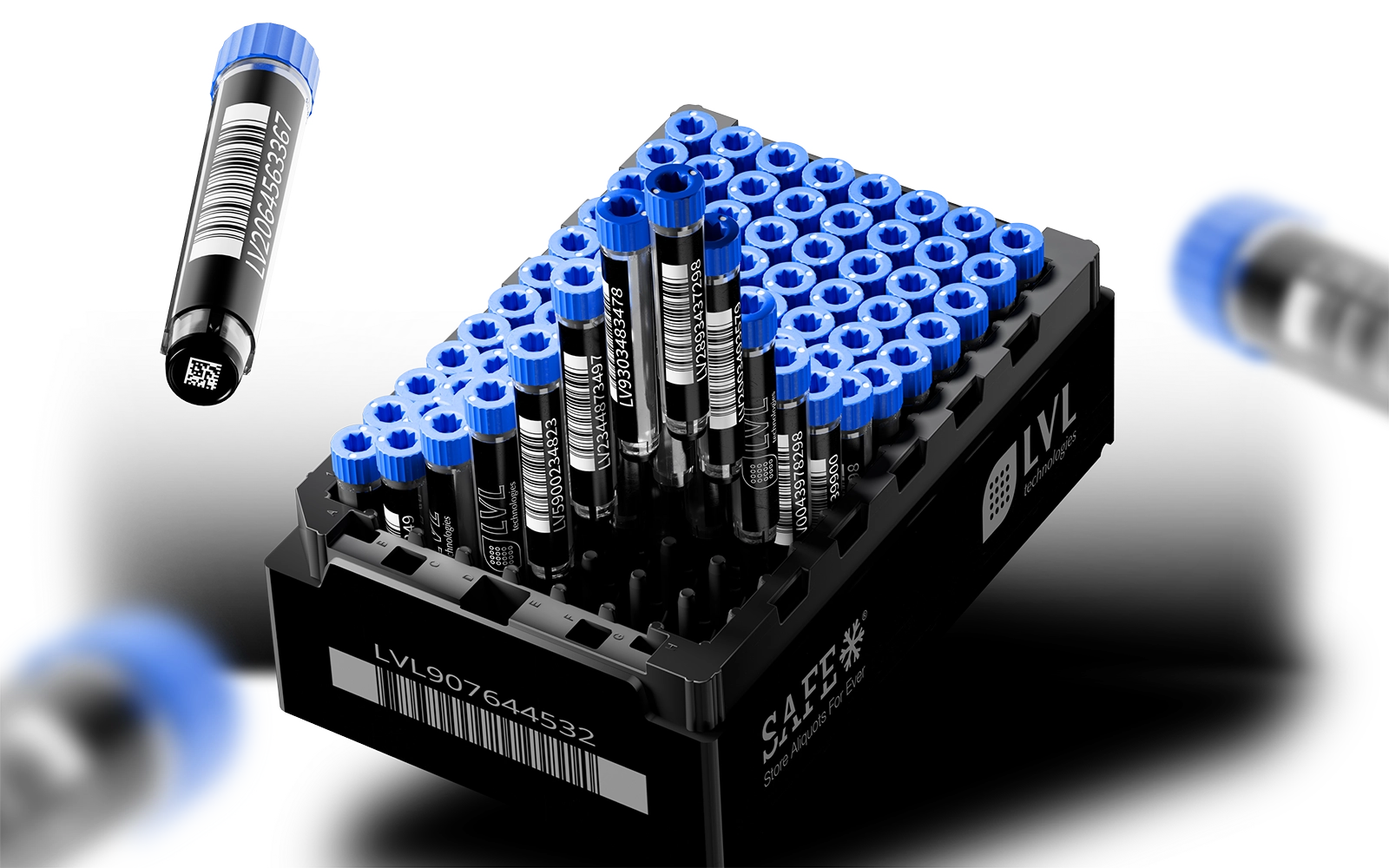
A 2D-coded tube is a sample storage vial with a unique DataMatrix or similar two dimensional code laser-etched or printed onto its base or side. Unlike traditional 1D barcodes that store data in a single row of lines, 2D codes encode information in a grid pattern, allowing far more data to be packed into a tiny space. This makes them ideal for high-density tube racks and automated laboratory workflows where speed and accuracy are non-negotiable.
The Core Qualities of a Great 2D-Coded Tube
1. Reliable, High-Contrast Code Etching
The barcode is only as good as its readability. A great tube features a laser-etched 2D code with sharp contrast and consistent depth — one that can be scanned reliably by automated readers even after years in ultra-low temperature (ULT) storage, repeated freeze-thaw cycles, or exposure to cryogenic liquids like liquid nitrogen.
Look for:
• Uniform cell size and spacing in the DataMatrix grid
• High contrast between the etched surface and the tube material
• Resistance to smearing, fading, or physical abrasion
• A code that reads from any orientation (true omnidirectional scanning) 2. Material Quality and Chemical Resistance
A tube that degrades compromises both your sample and your data. Premium 2D-Coded tubes are manufactured from high-grade polypropylene or similar materials that resist:
• Cryogenic temperatures (as low as -196°C in liquid nitrogen)
• Chemical exposure from common solvents, DMSO, acids, and bases • UV light degradation during long-term storage
• Physical stress from automated pipetting and robotic handling
The material must also be non-reactive with biological samples — essential for preserving DNA, RNA, proteins, serum, and cell cultures without contamination or adsorption.
3. Secure and Consistent Closures
Leakage is catastrophic in any lab setting. A great barcoded tube pairs its tracking capability with a reliable sealing mechanism. This might be:
• Screw caps with internal or external threads for a tight, leak-proof seal • Push caps or pierceable caps for high-throughput environments • Cap colors that provide a secondary visual identification layer
Whatever the format, the closure must maintain its integrity across freeze-thaw cycles, under centrifugation, and in automated capping/decapping systems.
4. Tube Geometry and Dimensional Consistency
In automated liquid handling and biobank management, dimensional precision matters enormously. A tube that is even fractionally out of spec can jam robotic arms, cause misreads, or fail to seat correctly in racks.
Great 2D-coded tubes are manufactured to tight tolerances, ensuring: • Consistent outer diameter and height across every tube in a batch
• Flat, unobstructed bases that allow bottom-reading scanners to capture the 2D code cleanly
• Compatibility with standard SBS-format racks (24-, 48-, 96-tube formats)
• Reliable performance with leading liquid handling platforms from Hamilton, Tecan, and others
5. Volume Options and Graduations
Sample volumes vary widely — from a few microliters in genomics applications to several milliliters in biobanking. A great 2D barcoded tube is available in a range of volumes
(commonly 0.5 mL, 1 mL, 2 mL, 4mL, 6mL and 8mL) with clear, accurate volume graduation marks to support consistent pipetting and sample management.
6. Traceability and Unique Identification
Every tube should carry a globally unique identifier — typically encoded in the 2D barcode and sometimes also printed in human-readable alphanumeric form on the tube side. This unique ID is the linchpin of your Laboratory Information Management System (LIMS), enabling:
• End-to-end sample tracking from collection to analysis
• Audit trails for regulatory compliance (GLP, GMP, ISO 17025)
• Rapid retrieval and reconciliation during inventory audits
• Integration with automated storage and retrieval systems (ASRS)
Finally, be sure to ask about how the process has been validated to eliminate duplicate codes. You don’t want to risk repeating codes.
7. Sterility and Cleanroom Manufacturing
For clinical and diagnostic applications, sterility is paramount. High-quality barcoded tubes are manufactured in ISO-certified cleanrooms and supplied pre-sterilized (gamma irradiated or ethylene oxide-treated) and certified DNase/RNase-free, pyrogen-free, and human DNA-free. This eliminates the risk of contamination before a single sample is collected. 2D Tubes by AutoGen offers either production sterile or post production sterilized.
8. Scanner Compatibility
A 2D-coded is worthless if your readers can’t reliably decode it. Great tubes are validated across a broad range of barcode readers — handheld scanners, rack readers, and integrated automation platforms. Look for manufacturers that publish scanner compatibility data and work with systems from vendors like Ziath, Brooks Life Sciences, Hamilton, and Thermo Fisher.
Why It Matters: The Cost of Getting It Wrong
A poorly manufactured 2D-coded tube doesn’t just cause a single inconvenience — it can cascade into sample loss, misidentification, regulatory non-compliance, and costly manual remediation. In clinical trials, biobanks, or diagnostic labs, a failed barcode read or
a degraded tube can mean a patient sample is lost irretrievably, an experiment must be repeated, or a compliance audit is failed.
Investing in great tubes is, quite simply, investing in the integrity of your science.
Questions to Ask When Evaluating a 2D-Coded Tube
Before committing to a tube supplier, consider these key questions:
1. How is the barcode put or etched onto the tube.
2. What third party testing and comparisons have taken place to demonstrate long term code integrity
3. What third party testing or certifications does the tube have to demonstrate non leakage and leaching?
4. What kind of material is the tube constructed of?
5. What third party testing and internal certificates are held to prove there will be no repeat codes?
6. What kind of guaranteed delivery lead times can you expect or receive?
Final Thoughts
A great 2D-coded tube sits at the intersection of materials science, precision engineering, and data integrity. It is more than a vessel — it is the physical anchor of your sample’s identity through every step of its journey. Whether you’re running a high-throughput genomics lab, managing a decades-long biobank, or processing clinical diagnostics at scale, choosing the right tube is one of the most consequential — and most underappreciated — decisions in laboratory management. At the end of the day – A Tube Is Just Not A Tube.
The best tubes disappear into the workflow seamlessly, never causing a failed read, a leaking sample, or a tracking error. And that invisibility? That’s exactly what great design looks like.
Looking to evaluate 2D-coded tubes for your laboratory or biobank? Consider requesting samples from multiple suppliers and running a head-to-head validation across your specific storage conditions, automation platforms, and LIMS integration before making a long-term commitment.
Through our partnership with LVL, 2D Tubes by AutoGen can deliver a scalable 2D sample management portfolio built for growth – without sacrificing efficiency, integrity or compliance. Get in touch to learn about the entire sample management product line.
www.2D-Tubes.com